 Most reviewed
Guides
Language
EnglishCurrency
US dollar · $GetYourGuide shows prices in the currency you choose.
Guide · Naval history
The submarine tunnels of the Bay of Kotor
Halfway between the islet of Our Lady and the open sea, the speedboats turn into a black mouth in the hillside. Here is what the submarine tunnels of the Bay of Kotor were for and how long you get inside.
Check availabilityfrom $53 · cancel without a fee
Editorial team, blue-cave-montenegro.comUpdated October 25, 2026about 6 min to read9 sources
At a glance
- 01What they are
- Pens cut into the hills to hide Yugoslav submarines.1
- 02Their last use
- They sheltered submarines and missile boats in 1999.1
- 03Length
- The tourism board lists one tunnel at over 100 m.2
- 04On the booked tour
- A 10-minute visit and photo stop.
- 05A real submarine
- Heroj, 50 m long, in the naval museum in Tivat.3
Tunnels in the hillside, built for hiding
From a distance the entrance looks like a cave with unusually straight edges. Then the boat slows, the concrete lintel comes into focus and you realise the mountain was hollowed out on purpose. The Yugoslav People's Army used submarine pens carved into natural hills, including in the Bay of Kotor.1 The idea was simple: a submarine parked inside a hill cannot be seen from the air.
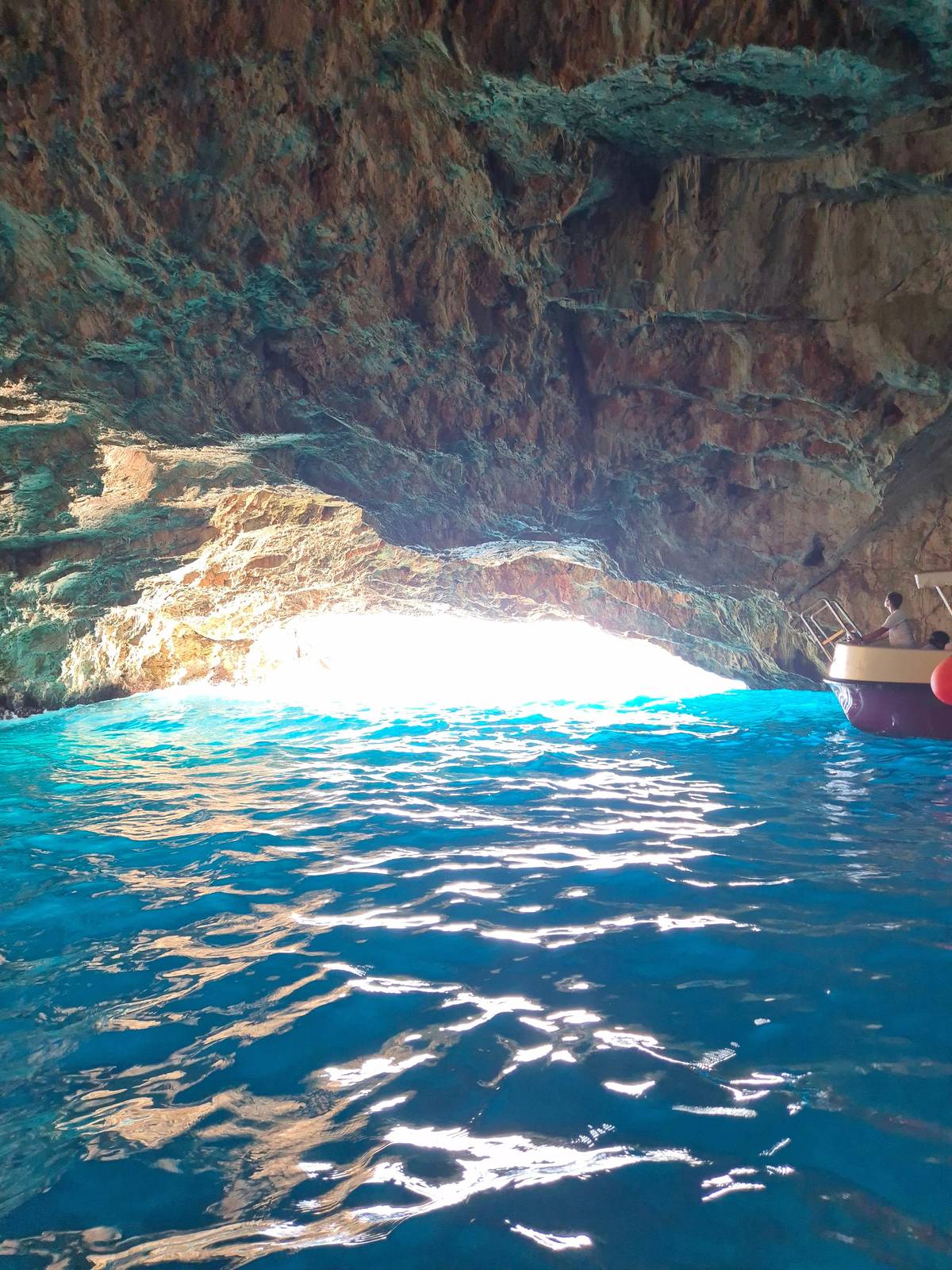
The national tourism organisation lists a walk through a former Yugoslav submarine tunnel spanning over 100 meters among the sights of a bay trip, next to the Blue Cave and the islet with the church.2 On a speedboat you do not walk; the boat idles into the tunnel and the light from the entrance fades behind you. The water inside is still and dark green, and your voice comes back from the walls a moment late.
These pens were not museum pieces. The ones in Montenegro did the job they were built for, sheltering submarines and missile boats from NATO air attacks during the 1999 campaign.1 What you glide past now is an empty tunnel in the rock, and the tunnels have become one of the stops that every Kotor speedboat tour seems to want on its poster.
A naval bay
From the Arsenal to the empty pens
-
19th century
Forts at the entrance
Arza, Mamula and Prevlaka guard the mouth of the bay.4
-
Austro-Hungary
The Tivat Arsenal
Founded by Admiral Maximilian von Sterneck.5
-
1967
Heroj launched
The submarine is launched on 21 August.6
-
1999
The pens in use
Submarines and missile boats shelter from air attacks.1
-
2004
Heroj retired
Decommissioned, then restored.7
-
2013
A museum piece
Heroj is laid up at the Porto Montenegro museum.7
Where the tunnels fit into the boat trip
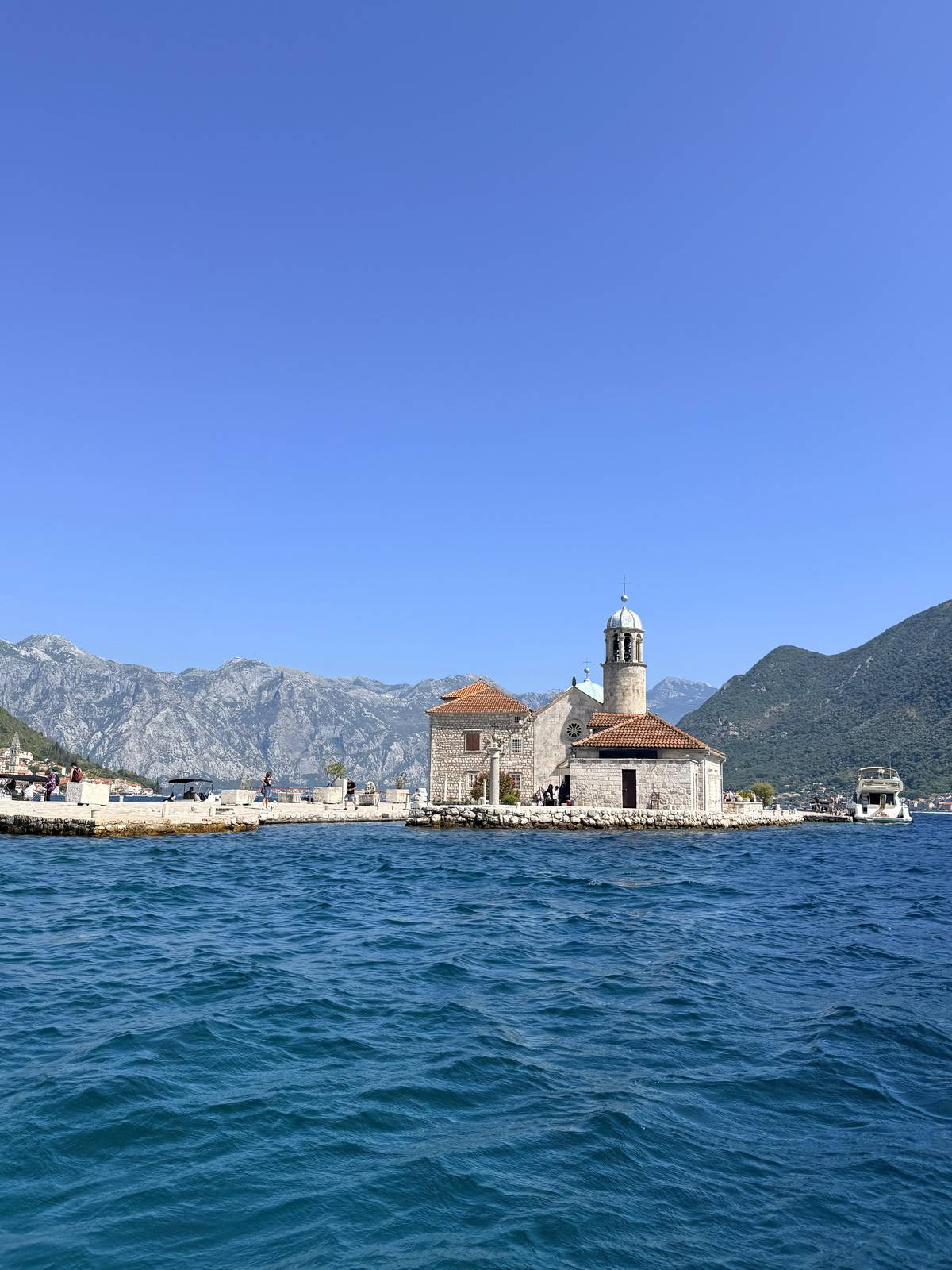
On the tour this site books, the tunnel comes after the islet of Our Lady of the Rocks. The boat runs 25 minutes from the islet, stops for a 10-minute visit and photo stop, then needs another 15 minutes to reach Mamula island. So it lies further out than the islet, on the way from the old Venetian towns toward the mouth of the bay.
Look around as you approach. The bay is a strategic place: three 19th-century Austro-Hungarian fortresses, Arza, Mamula and Prevlaka, guard the point where it meets the open sea.4 Long before the submarines, Tivat was already a naval town; its Arsenal was founded by the Austro-Hungarian admiral Maximilian von Sterneck.5 The tunnels are the last chapter of that long military story, written in concrete.
Which tunnel your boat enters, and whether it enters at all, depends on the operator and the day. Listings name the stop only as a former submarine tunnel and give it between 5 and 15 minutes. On a calm morning there may be another boat inside already; the skipper waits his turn or moves on, so do not plan your photos to the second.
Minutes inside
How long tours stop at a submarine tunnel
min
Three tunnel tours
From Kotor or from near Tivat
Most reviewed Longest tunnel stop
Tunnels & Mamula
Opatovo Pier, Donja Lastva
- Length
- 2 hrs
- Tunnel
- 15 min
- Cave
- 30 min
- Price
- from $45
 Shortest
Cave & old tunnel
Saint Roko dock, Donja Lastva
- Length
- 100 min
- Tunnel
- 5 min
- Cave swim
- 20 min
- Price
- from $45
Decision helper
How much tunnel do you want?
Pick what matters most to you
The 2-hour Tivat boat
It stops 15 minutes at the tunnel.
The booked speedboat
A 10-minute tunnel stop between the islet and the cave.
The naval museum in Tivat
Heroj is open to visitors in Porto Montenegro.8
The Tivat beach day
5 minutes at the tunnel, 1.5 hours on Žanjice beach.
The 100-minute boat
It covers the cave and the tunnel from Donja Lastva.
The ones in Montenegro fulfilled their purpose, housing and protecting the submarines and missile boats from NATO aerial attacks during Operation Allied Force in 1999.
How long each tour stays at the tunnel
Most tours treat the tunnel as a short stop. The booked tour and its closest rival both give it 10 minutes. Other Kotor loops keep it to a 5-minute photo stop, often at the end on the way home. Five minutes is enough to glide in, take a few pictures and turn around, but not enough to let your eyes adjust and look properly at the walls.
The longest stop in our comparison belongs to a 2-hour boat from Opatovo Pier in Donja Lastva near Tivat, which gives the tunnel 15 minutes. Tivat sits much closer to the outer bay than Kotor, so less of the morning goes on the ride and more on the stops. If the tunnels are your favourite part, starting there makes sense.
A 6-hour boat from Tivat visits the tunnel for 5 minutes, then Mamula, the Blue Cave and 1.5 hours on Žanjice beach. It is the lazy version: less history, more swimming. Whichever you pick, the tunnel stop is often marked optional on the listing, so it can change on the day.
Checklist
For the tunnel stop
01
Bring
- A waterproof pouch or wrist strap for your phone
- A light layer for the fast ride back
- Sunglasses for the glare at the exit
02
Expect
- A short stop, often 5 to 10 minutes
- Other boats waiting their turn
- The stop changed or skipped on rough days
Cost calculator
A tunnel and cave trip for your group
Starting totals for boats that visit a submarine tunnel.
People
Total from$105
each from $53
Check availabilityfree cancellationA total here is the lowest per-person starting price on GetYourGuide times the size of your group, converted with the European Central Bank's daily reference rate; the date and option you pick set the final amount.
Video
Inside a Hidden Submarine Tunnel in Montenegro
The YouTube player stays off until you press play.
Getting good pictures in the dark
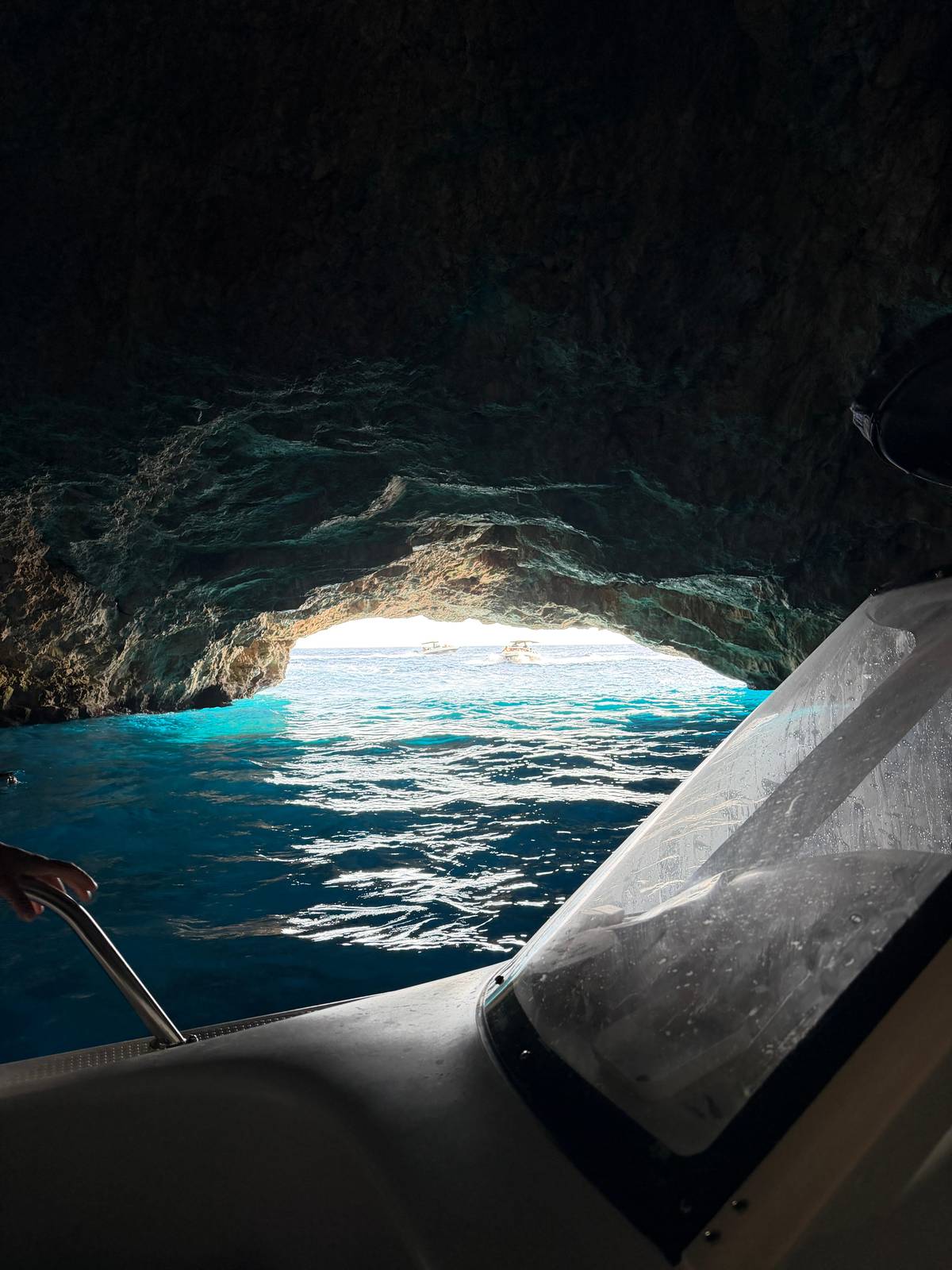
The light inside a submarine pen is a photographer's puzzle. The entrance blazes white behind you and the far end disappears into darkness, so your phone will try to expose for one and lose the other. Turn around and shoot back toward the entrance: the black silhouette of the tunnel framing a bright rectangle of bay and mountains is the picture most guests come home with.
Hold the phone still against the rail of the boat rather than at arm's length. Night mode, if your phone has it, helps with the walls, but the boat moves, so keep shots short. A small waterproof pouch or a wrist strap is worth more here than any lens, because the boat rocks as it turns and nobody wants to watch a phone sink into still green water.
Remember that the speedboat is moving between stops at speed. Put the phone away before the skipper opens the throttle again; the ride to Mamula is bumpy in the open part of the bay, and the best views of the fortress come in the few minutes when the boat slows down to pass it.
Heroj, the submarine you can step inside
If the empty tunnels leave you curious about what they once held, go to Tivat. In Porto Montenegro visitors can enter the submarine Heroj, 50 m long and built in 1968.8 It was built for the Yugoslav Navy, launched in 1967, served for more than two decades and is now preserved beside the Naval Heritage Collection.3
Its story has a few precise dates. Heroj was launched on 21 August 1967, sponsored by the commander of the Yugoslav Navy, Admiral Mate Jerković.6 It was decommissioned in 2004 and, after restoration, laid up at the Porto Montenegro museum in 2013.7 The sources give two years: the national tourism organisation says built in 1968, Porto Montenegro says launched in 1967.83
The Naval Heritage Museum itself is housed in a restored 19th-century sawmill and shows more than 300 artefacts, including Austro-Hungarian naval equipment and a pair of Yugoslav submarines.9 It makes a good plan for the afternoon after a morning tour, and a sheltered one on a day when the open sea keeps the boats away from the Blue Cave.
Tunnels plus cave: building your morning
Because the tunnels are on the way out to the open sea, nearly every Blue Cave tour can include them at little extra time. On the booked tour, the 10-minute tunnel stop sits between a 20-minute break on the islet and an optional 30-minute swim at the cave. That balance of history and water is the reason it suits first-time visitors who want a little of everything.
From Tivat the order changes. A 100-minute speedboat leaves the dock in front of the church of Saint Roko in Donja Lastva, passes Mamula, swims at the cave for 20 minutes and photographs the tunnel for 5 minutes on the way back. It is rated 4.78 from 87 reviews and starts from $45. The shorter ride leaves time for the naval museum in Tivat the same day.
Whatever you choose, keep expectations honest. The tunnel is a few minutes of cool dark water and echoing concrete, not a guided museum. It works best as the quiet moment between the church and the swim, a reminder that this beautiful bay was, not long ago, a place that armies wanted to hide in.
Into the blue
Church, tunnel, fortress, then a swim
3 hours by speedboat from Kotor, with an optional 30-minute swim at the cave.


You ask,we answer.
What are the submarine tunnels in the Bay of Kotor?
Old navy pens cut into the hills. The Yugoslav People's Army carved them to house and protect submarines.1
Can you go inside the submarine tunnels?
Yes, by boat. The booked tour stops for a 10-minute visit and photo stop.
How long is the submarine tunnel?
It depends on the tunnel. The national tourism organisation lists one former Yugoslav tunnel at over 100 meters; the listings do not say which tunnel they visit.2
When were the tunnels last used?
In 1999. They sheltered submarines and missile boats from NATO air attacks.1
Which tour spends the longest at the tunnel?
A 2-hour boat from Tivat. It gives the tunnel 15 minutes.
Can I see a real Yugoslav submarine?
Yes, Heroj in Tivat. The 50-metre submarine is preserved at the Porto Montenegro naval collection.3
What else is in the Naval Heritage Museum?
More than 300 artefacts. It is set in a 19th-century sawmill, with Austro-Hungarian naval equipment.9
Sources
Where the information comes from
- 1Wikipedia (last resort)Submarine pen↩
- 2National Tourism Organisation of Montenegro (montenegro.travel)Boat trips↩
- 3Porto Montenegro (Naval Heritage Collection operator)The Submarine Heroj↩
- 4National Tourism Organisation of Montenegro (montenegro.travel)Fortresses↩
- 5Tourist Organisation of TivatCulture↩
- 6Wikipedia (last resort)Heroj-class submarine↩
- 7Wikipedia (last resort)Heroj-class submarine↩
- 8National Tourism Organisation of MontenegroThe most popular museums↩
- 9Porto Montenegro (Naval Heritage Collection operator)Naval Heritage Museum↩
Keep reading